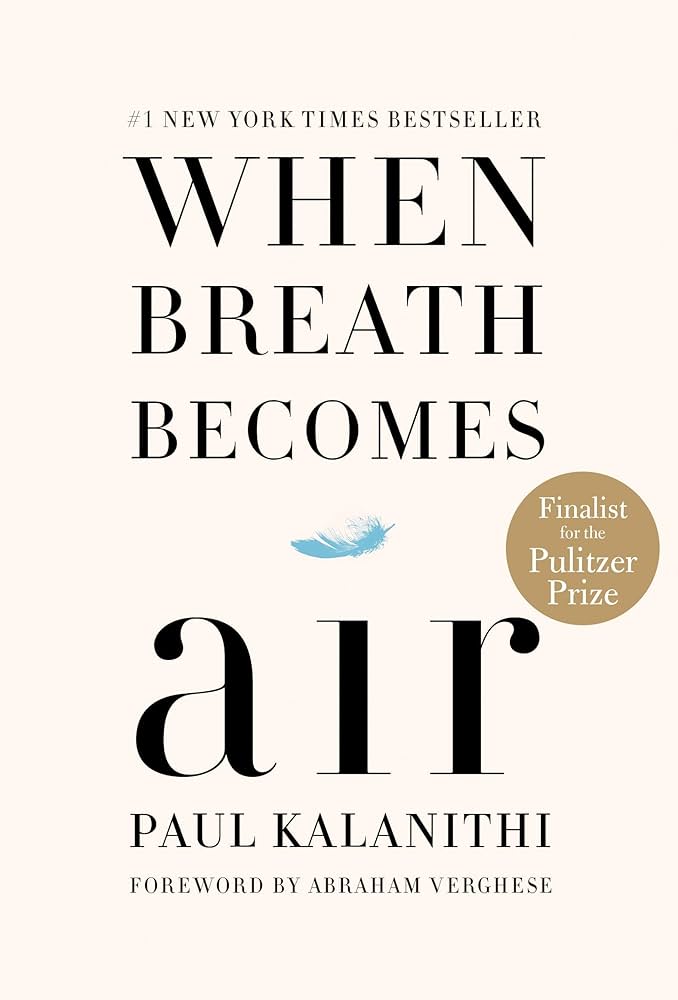
A final letter to his journey in defining life, Paul Kalanthi’s When Breath Becomes Air, he explores mortality, future, and identity. Paul Kalanthi, an American neurosurgeon and scientist, wrote this book during the end of his life, inspired by his battle with stage IV lung cancer. After spending his career with nary a semblance of experience of how his patients persevere, Kalanthi is channeled into their internal world, becoming a patient himself and truly learning what being a doctor means. Throughout the book, he draws parallels from his time as a medical student and his own experiences as his two personas; one in a meek patient’s gown and one in a commanding doctor’s scrubs.
Paul Kalanthi structures his book in chronological order, beginning with his childhood fascination with what makes life meaningful. He seeks salvation through language and literature, but finds it descends into “[feeling] as weightless as the breath that carried them,” (pg. 43), following the path of neurosurgery in its stead. Just as neurosurgery may provide more concrete and biological answers to Kalanthi’s questions about mortality, I chose engineering because it allows me to directly engage with efforts to improve humanity, rather than simply describing what actions should be taken. Paul argues that neither science nor engineering itself can account for how humanity functions. Engineers, doctors, researchers, sanitation workers, alcoholics, all hold a big piece of the pie that allows us to understand human wisdom and invoke progress.
Yet, within this system of human effort, When Breath Becomes Air, displays a striking disconnect between doctors and patients, each holding knowledge and fear, but are often ignorant of the other’s internal world. The first part of the book is Kalanthi illustrating his journey in becoming a doctor in a succinct and impersonal fashion. Alongside tales of excruciating hours and his need for perfection, he shares a popular anxiety; his technicality is reducing his patients to paperwork. This complements his second part where he realizes statistics and Kaplan Meier survival curves aren’t soothing remedies to those struggling. He uses more figurative language and questions elements of philosophy from text much more. Contrary to what you may believe, doctors struggle with maintaining their humanity and compassion, as shown by Kalanthi while dissecting cadavers. Surgery requires focus, but doctors only feel the wear of the day “like runners crossing the finish line only to collapse,” (pg 125). What I find interesting is how this relates to doctors being blindsided and cursed by their own knowledge, especially how they rarely donate their bodies for dissection and how they often underreact when self-diagnosing because they’ve learned to live alongside the weight and familiarity of mortality and clinical transparency. We can see gaps in many doctors, such as in one’s ego, as we see when Kalanthi confronts his doctor for refusing to supply an important medicine because he lacks an understanding of the severity of his situation. Kalanthi himself, is blindsighted when it comes to his own ego too, describing the achievements and privileges of his life like counting chickens. This is the reasoning behind why therapists need their own therapists as well. In the last few years of his career in neurosurgery, Kalanthi feels as if his job has become joyless, only doing it to overcome the nausea, pain, and fatigue from his trauma. I believe his returning to his passions after supposedly recovering is a sign of burnout. When my mind began recovering from years of internal pressures, I could not continue working with the same creativity and quantity. I still struggle to even touch my passions, which previously served as liferafts during hard periods. When passion becomes something to mourn, it’s as if your soul forgets its language, its body. In When Breath Becomes Air, Paul Kalanthi’s mind experiences a similar unravelling, only his comes with a diagnosis that redefines everything.
Once Paul Kalanthi is diagnosed with lung cancer, the roles reverse. His treatment process gives him a new perspective on his patients, who he describes are enduring hardships as objects of action. His own doctor rejects any attempts at providing him with a precise survival curve, instead calmly explains the options of treatment rather than overwhelming him with all the risks and complications. In that period, Kalanthi receives the kind of care he once struggled to give, care rooted in sympathy, not prognosis.
As a patient, Kalanthi’s view of mortality and the role of neurosurgery become clear. He learns intelligence or moral qualities are enough for a doctor to make judgement calls.
With cancer, Kalanthi’s time is too brief, his own dying body interferes with his life. Nearing the end of his life, time goes faster, both as he is determined to keep writing, and with the anecdotes that are further from each other and shorter in length. During this time, he cannot know the time interval of his expected survival, but he carefully plans out his last years. Despite accusations of selfishness, he decides to have a child. Despite declining passion and no promotions, he continues neurosurgery. And, of course, he returns to literature and writes this book. All to regain and maintain his identity in the face of mortality.
Paul Kalanthi later introduces a fascinating topic where humans are subject to physical laws, like time, but diseases are chaos. Although I disagree with his description of humans, his perspective on diseases was previously foreign to me. Doctors must operate this tension as death’s ambassador, as Grim Reapers who comfort and guide their patients for as long as they are together. And they, as ambassadors, should speak the patient’s language. I believe, since death and disease are natural processes, doctors are human, and shouldn’t be chastized for the death of others through their work. Surgeons bring in a perspective to patients after life-changing diagnoses, guiding them on how they will proceed with their life, what future they would want, and what gives meaning to their life. Paul Kalanthi’s doctor, Emma, does just this. She suggests medication to protect his hands so he can continue operating. When he admits to rethinking his future in neurosurgery, she insists: If surgery is important to him, he should take the pill. Her insistence reveals a deeper truth: Patients shouldn’t be forced to return to their old lives, but made to face their new existence. This shift, from preserving the past to confronting the present, extends beyond the patient. It touches families too, who must navigate their grief in real time. Some family members choose to obtain closure with the past and burn the present, some might find the burden of a degrading soul too heavy, and visit with increasing rarity. These choices are so painful, complex and deeply human. In those final moments before death, families’ conversations with their neurosurgeons may impact their decision to peacefully let go or have open sores of regret.
Doctor-patient relationships mean meeting patients where they are and walking alongside them as far as you can. When Breath Becomes Air’ s message is targeted towards the general public for them to better understand doctors, but it is especially relevant for an audience of medical professionals who aim to aid and understand their patients. Prior to reading, I had no semblance of an idea on the different mentality doctors may develop. Paul and I have questioned similar concepts in different fields, and that makes me wonder where I will end up, hopefully not as out-of-touch. Considering the book’s final thoughts on death: It matters not what time you have, but rather what you do with it. As Kalanthi writes,“Persistence is the defining characteristic of the organism thriving,” (pg. 143). Sometimes this persistence means choosing accuracy over precision, compassion over control, and meaning over time.