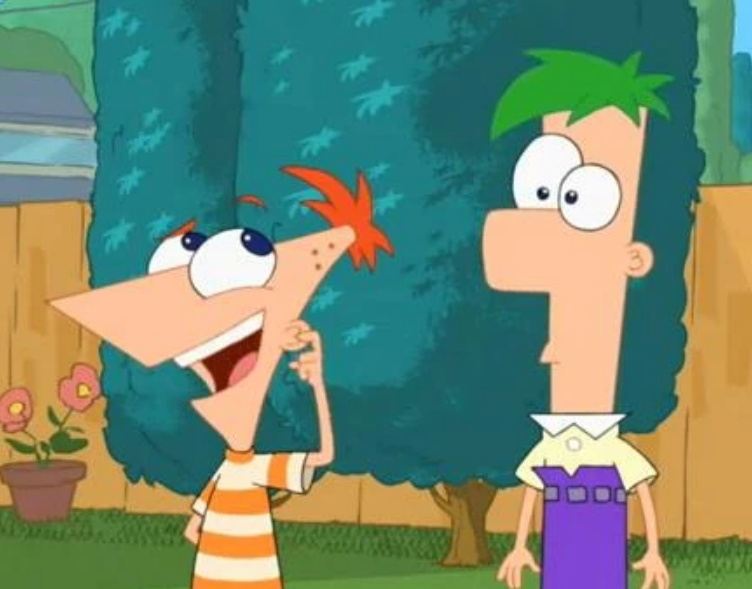
There’s 104 days of summer vacation, and I’ve spent every summer watching Phineas and Ferb—and then rewatching them all again. If there was ever a blueprint for imagination without limits, this show was it. Every day, Phineas would say, “Ferb, I know what we’re gonna do today!” and off they’d go—building rollercoasters, time machines, submarines, and even launching themselves into space. While most kids saw entertainment, I saw possibility. I saw engineering. I saw my future.
My obsession began early. While other kids watched casually, I was in the trenches—rewinding episodes to understand how Phineas rigged that zipline or how Ferb launched that backyard rocket. I built things out of cardboard and duct tape and drew endless blueprints for my “inventions.” Most of them flopped. (Okay—all of them flopped.) But failure never stopped Phineas and Ferb, so why should it stop me?
Their world was wild, unpredictable, and scientifically impossible, but it planted a real idea in my very real, very tiny world. Which leads me to my endless what ifs: what if I could build like them, but for real? What if I could be the person who sends rockets into orbit, crafts the next Mars rover, or designs aircrafts that slice through the sky? I didn’t have a genius platypus, but I had curiosity. I had questions. And I wanted to build things that flew.
In middle school, I joined the science fair and made a soda-bottle rocket. It was a disaster. But I went home that night and looked up thrust, drag, and lift. I didn’t just want to launch a rocket—I wanted to understand why it flew. And that’s when I started chasing aerospace engineering not as a fantasy, but as a goal. I filled notebooks with sketches and equations. I followed NASA’s every move. I watched real rocket launches and whispered “wow” like it was the only word in my vocabulary.
High school hit hard, like it always does. There were moments I doubted myself; too many formulas, too many tests, not enough sleep, and the constant voice in my head saying, You’re not smart enough for this. But then I’d remember Phineas standing confidently in front of some wild contraption, surrounded by naysayers, smiling like he had all the answers. His belief in himself, and in the joy of building something just because he could, reminded me of why I started in the first place. Because dreaming big isn’t childish, it’s revolutionary.
Phineas and Ferb taught me that science doesn’t have to be dry. It can be loud, colorful, full of music, laughter, failure, and triumph. They taught me that creativity and engineering are best friends, not opposites. That’s exactly how I want to approach aerospace engineering. Not just with formulas, but with wonder. Not just with knowledge, but with imagination.
So now, as I look ahead to college, I’m chasing the dream of turning my childhood inspiration into something tangible—whether that’s working on the next reusable spacecraft, improving flight tech, or discovering new ways to explore the stars. I still hear that theme song in my head sometimes. It doesn’t just bring me back, it pushes me forward.
Like Phineas always said: “We’re gonna need a blowtorch and some soda cans.” I’d just add, “and a degree in aerospace engineering”.