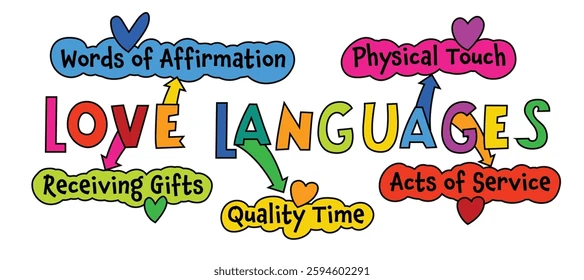
John Gottman, American psychologist and professor, describes how the essence of love is building a strong connection with your partner by adhering to each other’s needs,“[p]erfection is not the price of love. Practice is. We practice how to express our love and how to receive our partner’s love. Love is an action even more than a feeling. It requires intention and attention, a practice we call attunement.” With ever changing relationship dynamics, understanding and reciprocating needs is important for the health of the relationship. In an increasingly globalized world, one theory in social psychology has served as a framework for couples, teachers, and therapists alike. Developed to decode the complexities of how partners express and receive love, Dr. Gary Chapman, a Baptist minister with a PHD in adult education, Five Love Languages has widespread cultural influence. Five Love Languages explains how each person has a primary and secondary love language- spending quality time with the partner, giving gifts, exchanging words of affirmation, performing acts of service to make one’s life easier, and physically touching them. Partners have to appeal or “speak” to each other’s love language for a successful relationship. They learn about the other’s language by analyzing what they request and dislike from their romantic partners. This paper will examine to what extent love languages influence relationship gratification. While Gary Chapman’s Five Love Languages provides a useful framework for understanding relationship needs, it falls short generalizing all relationships with Western values and studies with questionable credibility.
Scientific validity
Gary Chapman’s Love Languages aren’t grounded in scientific research. As noted by acclaimed writer Feiler, 2011, Chapman himself acknowledges his model was never intended to be for academic purposes, “Most people are not going to read an academic book on marriage..the normal person wants to know, “What is going to help me?”’ The framework of his theory is intended for accessibility, not accuracy. Like the famous Myers-Briggs personality tests, love languages may have intuitive appeal, their abstract nature means it cannot account for the complexity of emotional needs or reconciliation. Since their popularity is not equivalent to their psychological validity, relying on them alone will neglect the deeper emotional work and problems required for true intimacy.
To further complicate matters, Gary Chapman relies on a narrow and homogeneous sample- mainly of Baptist, married, heterosexual white couples in North Carolina in the 1980s and 1990s that share similar values to establish his theory. He developed the theory of the five love languages under a specific cultural context of traditional Baptist values, relying on classic situations of wives frustrated over household chores, having wives being “too emotional”, or less sexually involved. These characterizations no longer fall in line with current relationship dynamics considering more broad and inclusive modern understandings of partnership. As Impett et al., (2024) comments, the love languages fall under rigid categories that do not include “support for a partner’s autonomy or personal goals outside of the relationship,” other important factors that may be meaningful for relationship satisfaction. The narrow perspective becomes especially problematic if applied to real-life scenarios. Let’s take a hypothetical case in which a woman named Emily needs counseling from Chapman regarding her husband’s bouts of anger and silent treatment. Under the assumption that Emily isn’t doing enough for her husband, Chapman proposes she should perform more acts of service for him, rather than address the root of the issue and communicate or explore the possibility of dissolving the relationship due to emotional abuse. In a similar situation, Chapman reportedly offers Bible passages about “loving one’s enemies,” (Scott, 2023) and proposes she cater to the husband’s respective love language, treating him like a child to incentivize better behaviour. These outdated ideas that love languages, regardless of their attitude or the overarching problem, can completely fix relationships is a dangerous and incorrect line of reasoning. Love languages cannot serve as the sole justification for a partner’s complicated inner conflicts.
Beyond these concerns, the love language theory oversimplifies human desires when categorizing desires. In real life, people don’t fit into neat boxes. They have dynamic personalities and relationships, “People tend to endorse all five love languages as meaningful ways of expressing love and feeling loved, regardless of their type” (Mostova et al., 2022). People tend to value all five love languages depending on the contexts. People in relationships need to value and use all types of love languages even if they may prioritize one more in different situations. Ignoring this nuance, may “ create a narrow understanding of what constitutes love, hindering the richness and diversity of emotional connections,” (Impett et al., 2024c). Trading-off one love language for another or leaving out other deeper emotional processes, such as attachment security, autonomy, and advocation and support, is a simplification of real life processes where all of these concepts can coexist. This is further proven by Dr Karantzas (2023), who is also a certified couples therapist, warns that relying on love languages makes relationships incomplete: “You are likely missing, and ignoring, the many ways we tend to try and communicate in a relationship…Often those blind spots are the places where the action needs to occur.” Love languages overlook the blind spots or deeper reasons behind why individuals may find it difficult to express or accept love, including the influence of past experiences and attachment histories on present relationship dynamics. Emotional satisfaction is context-dependent. While love languages help partners express affection, true emotional intimacy is built by understanding and responding to each other’s attachment needs, fostering safety, trust, and attunement beyond mere romantic gestures. Thus, a comprehensive understanding of the various factors that influence relationship satisfaction can aid in the development of effective interventions and strategies to promote healthy and fulfilling relationships. In situations of stress, the use of the preferred love language may not be appropriate. An individual experiencing a breakup or suffering mourning may prefer quality time or autonomy rather than irrelevant words of affirmation, for example (Katica Stoimenovska Mantova, 2023). In these scenarios, personality and circumstances can be more beneficial to consider and comfort.
In an era where there’s a public desire for simplistic, accessible solutions, pop-psychology trends, such as love languages, spread like wildfire. Originally intended as a better way to understand how to connect with relationship partners, they have provided a tool for self-characterization on dating apps and everyday conversation. Yet this labelling often leads to oversimplifying people by putting them into rigid categories and unintentionally undervaluing other meaningful ways of expressing love. While love languages can serve as a gateway to understand unmet and different needs in a relationship, they are not a fixed universalizing formula that works for everyone. Humans love in many ways, not just one, and while emotions may not change, methods of handling our reactions and relationships afterward can, whether that be through love languages or other scientifically proven methods. As Gary Chapman himself notes, it’s easier to adapt how you act than change how you feel.
Works Cited:
Feiler, B. (2011, November 19). Can Gary Chapman Save Your Marriage? The New York Times. https://www.nytimes.com/2011/11/20/fashion/can-gary-chapman-save-your-marriage-this-life.html
Impett, E. A., Park, H. G., & Muise, A. (2024b). Popular Psychology Through a Scientific Lens: Evaluating Love Languages From a Relationship Science Perspective. Current Directions in Psychological Science, 33(2). https://doi.org/10.1177/09637214231217663
Mostova, O., Stolarski, M., & Matthews, G. (2022). I love the way you love me: Responding to partner’s love language preferences boosts satisfaction in romantic heterosexual couples. PLOS ONE, 17(6). https://doi.org/10.1371/journal.pone.0269429
Scott, K. (2023, September 4). The origin of the five love languages might surprise you. ABC News. https://www.abc.net.au/news/2023-09-04/origin-of-five-love-languages-might-surprise-you/102764046
Languages, L. (2025, April 30). Dannette Escobedo Counseling. Dannette Escobedo Counseling. https://www.decounseling.com/blog/why-the-five-love-languages-arent-enough-to-build-a-deep-connection-in-your-relationship
Katica Stoimenovska Mantova. (2023, March 31). EXPLORING THE CONNECTION BETWEEN LOVE LANGUAGES AND RELATIONSHIP SATISFACTION. ResearchGate; unknown. https://www.researchgate.net/publication/375462984_EXPLORING_THE_CONNECTION_BETWEEN_LOVE_LANGUAGES_AND_RELATIONSHIP_SATISFACTION
Annotated Bibliography
Feiler, B. (2011, November 19). Can Gary Chapman Save Your Marriage? The New York Times. https://www.nytimes.com/2011/11/20/fashion/can-gary-chapman-save-your-marriage-this-life.html
Impett, E. A., Park, H. G., & Muise, A. (2024b). Popular Psychology Through a Scientific Lens: Evaluating Love Languages From a Relationship Science Perspective. Current Directions in Psychological Science, 33(2). https://doi.org/10.1177/09637214231217663
Mostova, O., Stolarski, M., & Matthews, G. (2022). I love the way you love me: Responding to partner’s love language preferences boosts satisfaction in romantic heterosexual couples. PLOS ONE, 17(6). https://doi.org/10.1371/journal.pone.0269429
Scott, K. (2023, September 4). The origin of the five love languages might surprise you. ABC News. https://www.abc.net.au/news/2023-09-04/origin-of-five-love-languages-might-surprise-you/102764046
Languages, L. (2025, April 30). Dannette Escobedo Counseling. Dannette Escobedo Counseling. https://www.decounseling.com/blog/why-the-five-love-languages-arent-enough-to-build-a-deep-connection-in-your-relationship
Katica Stoimenovska Mantova. (2023, March 31). EXPLORING THE CONNECTION BETWEEN LOVE LANGUAGES AND RELATIONSHIP SATISFACTION. ResearchGate; unknown. https://www.researchgate.net/publication/375462984_EXPLORING_THE_CONNECTION_BETWEEN_LOVE_LANGUAGES_AND_RELATIONSHIP_SATISFACTION
Editor’s note: This is a research paper written by Mancolli for her AP Seminar class.