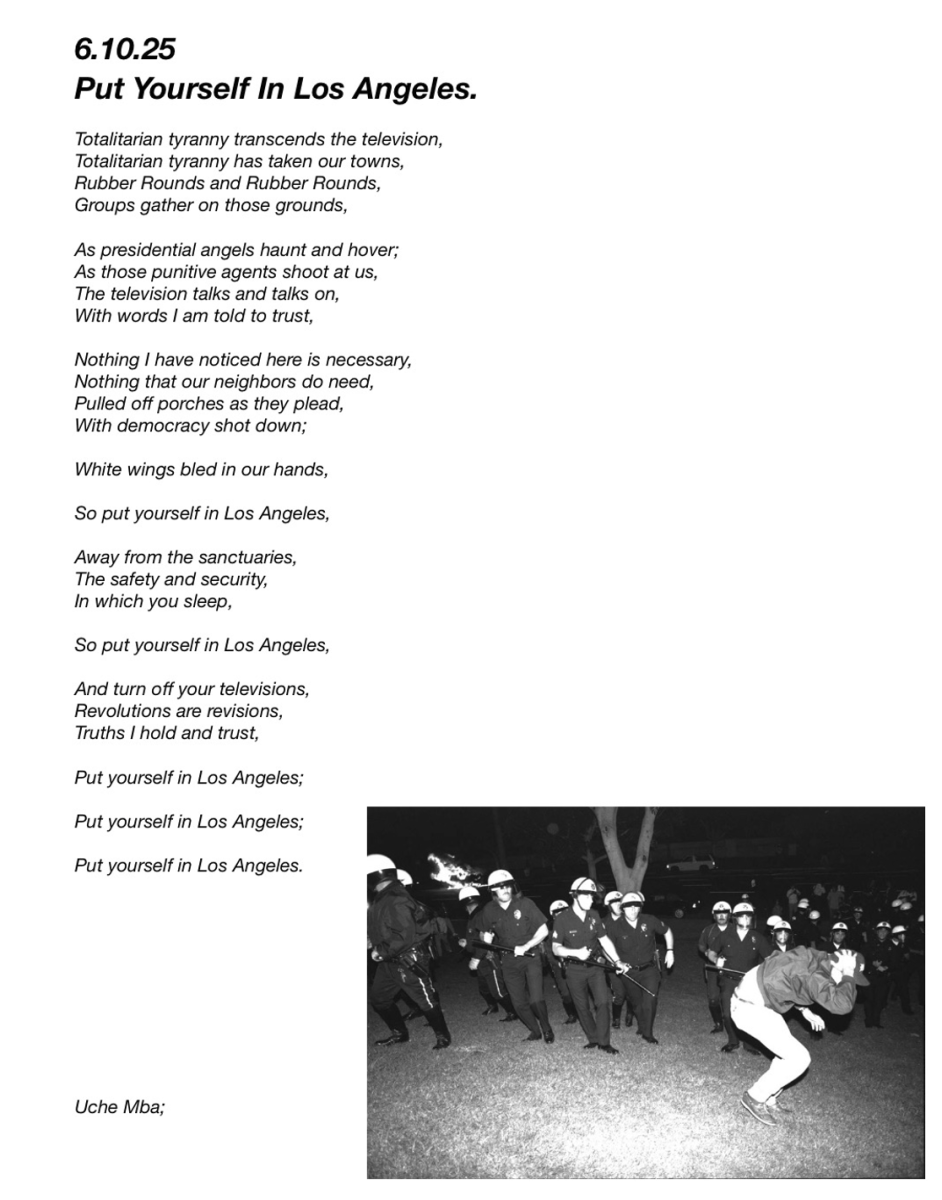
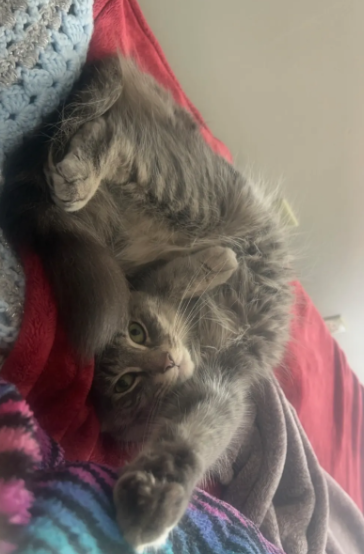
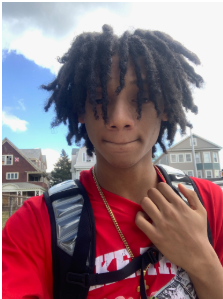
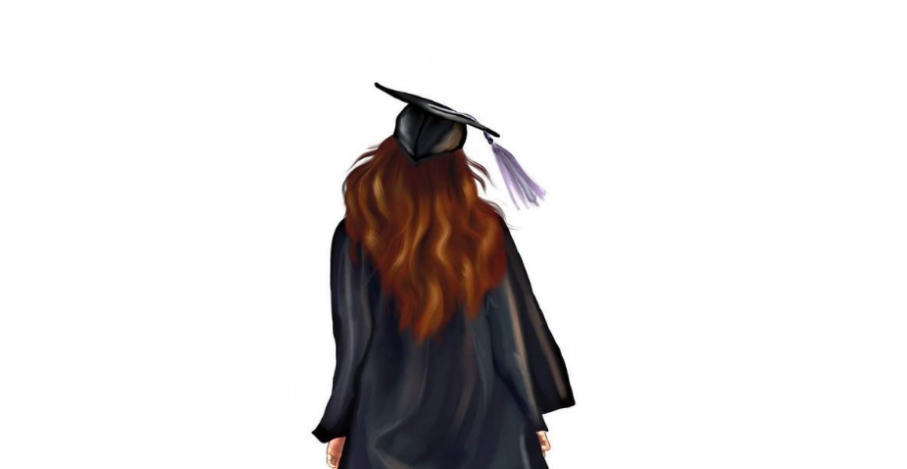
Uchenna Mba: it’s a name that almost all of us here at South High Community are familiar with. As a well-established athlete and the Vice President of our very own Senior Class, Uche has made his way up the popularity ladder at a remarkably fast pace. He waves to every friendly face in the hallways, smiling and joking with anyone that comes his way. While it seems to almost everyone that Uche is a well-known figure, it may not actually be the case.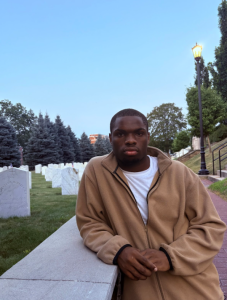
How many of you knew before reading this today that Uche Mba is a poet?
The answer to that question is likely a very, very slim number, but one that I’m a part of. Fortunately, I had the opportunity of befriending Uche in Ms. Senko’s physics class, which both of us had taken in our junior year.
As someone who holds a great amount of passion for the English language and its arts, I knew immediately that his interest in poetry was something I wanted to learn more about. Eventually, I even became an editor for a collection of his poetry. When I was approached with the concept of a poetry spotlight on Uche, I had to say yes.
Below, you will find the interview that I had the joy of running with Uche, and I hope you enjoy it as much as I did!
1. Do you remember the first poem you wrote? What inspired you to write it?
My first official poem was written in February 2022 during a writing course at Bard College. At the time, I gave little to no effort during that six week course.
Some months later, after attending a leadership camp at Northwestern University, I wrote my first intentional poem titled Mid America. It was inspired by the diversity of my classmates there. The poem tells the story of a young African American with no ties to Africa, yet unwanted in a small conservative town. I explore racism, resentment, and the struggle of understanding yourself through others. These themes would go on to be cornerstones of my work.
2. Do you write your poetry with a specific aim or purpose in mind?
I tend to write when I have a headache. I use the term “writing them off.” My headaches stem from many things – stress, people, questions, society, the future.
My purpose is to collect those frustrations and release them into poems or prose. Afterward, I look back and try to make sense of it all – moving from a micro perspective to a macro one.
3. Have any writers, authors, or poets inspired your own work?
Sarah Kane is my biggest influence. I read her play Cleansed in 2022, and it became my blueprint for writing. The play explores people overcoming oppression through acts of love.
Through her work, I’m drawn to confronting suffering – exposing brutality, love, and survival in their rawest forms. I believe discomfort has meaning, and that witnessing pain honestly can create empathy, connection, and purpose rather than silence.
4. A lot of your poems (those published under the “untitledsoftlaunch” Instagram handle) tend to have political themes. To you, what is the importance of speaking out about politics?
Building on the idea of people overcoming oppression through love, I write about political issues through my own perspective. There is urgency today to speak on issues that have existed for many yesterdays and will continue into tomorrow.
I write about poverty in America, my views as a pacifist, feminism, class issues, LGBTQ rights, addiction, environmentalism, masculinity, religion, and more.
I recognize the privilege of being American, and I write about both those who express the greatest of American freedoms and those who threaten them. I have found solace in being an outsider, and I’ve met many who feel the same. I tell their stories – immortalizing them.
5. What’s the typical writing process for a poem? How long does it take for you to create a poem, start to finish?
Consumption: I consume media to spark inspiration – music, photography, literature, or simply people.
Title: I choose a title based on what I’ve consumed.
Theme: I select one overarching theme, usually broad and open. I should be able to summarize the poem under one idea – something even mundane.
Question: What am I questioning? Why am I writing this?
Meaning: After writing, I analyze the work and determine its deeper meaning.
6. Do you think anyone would be surprised that you write poetry? Why or why not?
Yes, I am seen only as my body, not my mind. People see a roughly six foot athlete, from football, to basketball, to track. I also tend to be a jokester of sorts, I smile, I laugh, and talk to everyone.
So when people see what makes me – my passions and hobbies, my poetry – it surprises them that I have layers. I have talked about my perception struggle with people from time to time, and in an email with a teacher I brought up this Myth of Uche Mba:
I come off as carefree but in all honesty I care a lot.
7. If you were to read one of your poems to everyone at South, which one would it be?
8. What do you hope to do for a career in the future? Will poetry be a significant part of that?
Poetry will never leave me, it is as simple as pulling my phone out and going to my notes apps.
I do dream though of being an Urban Planner or Architect. I grew up drawing maps, memorizing populations, and taking note of city layouts. I dream of infusing environmentally beneficial community spaces, cultural hubs, artistic places that are melting pots of intellectualism.
9. What advice would you give to your past self, when you’d just started writing?
Be more observant.
I live by “Love All; Be All” now and would tell my old self to be the people around him. I believe through others, self is made.
Uche’s poetry –and his story overall– serves as a reminder to us that our perceptions of a person can fall flat, and that what we think we know about someone is just the surface.
While there’s no denying that he’s an unstoppable force across the board in his athletics, there’s also no denying that Uche is an amazingly accomplished writer with a promising career ahead of him.
He’s a multi-faceted person, and viewing him with this combined perspective really works to change your world-view.
As Uche himself said in this interview, “Through others, self is made.”
By getting to know friends, acquaintances, and even simple peers on such a deep and profound level, our sense of self is greatly enhanced.
There is always more to discover about the people (and the world) around us, and in opening our eyes to these discoveries, we in turn begin to learn more about ourselves.
Next week, we will run a collection of poetry by Uche – don’t miss it! Until then, enjoy the poem below that Uche identified as the poem he especially wanted to share with the South High community:
If you were to read one of your poems to everyone at South, which one would it be?
I would read my poem Put Yourself In Los Angeles. Taking into account the demographics of South High, this poem feels appropriate. Put Yourself In Los Angeles resonates with my school because we are a mix of many diverse people with immense leadership potential. In the poem, I address immigration enforcement in Los Angeles and other American cities, and I reflect on how the freedom and livelihood of people – not unlike those I see in class – can be threatened.
I also question the role of the news and media, writing, “The television talks and talks on / With words I am told to trust,” highlighting how we are informed about injustice without being moved toward meaningful action. That complacency builds toward the lines, “With democracy shot down / White wings bled in our hands,” suggesting that democracy is something we hold and therefore something we are responsible for protecting. The poem closes with a call to action: “So put yourself in Los Angeles / And turn off your televisions / Revolutions are revisions / Truths I hold and trust.”
Worcester, in many ways, reflects Los Angeles – cities built on the beauty of diversity – so my poem is a call to my peers to preserve the integrity of our cities, schools, and lives. I want them to put themselves out there and have a hand in history.